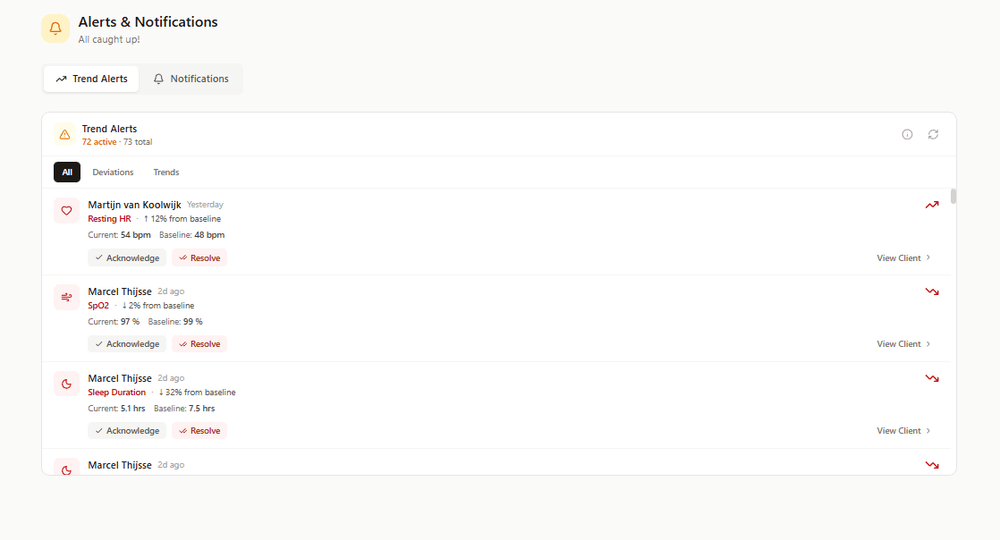
CardioMood Smart Alerts continuously monitor all your clients' vital signs and automatically notify you when something needs attention. Instead of manually checking dashboards or waiting for clients to report problems, you get proactive notifications when metrics indicate potential issues - often days before clients notice symptoms themselves. It's like having a vigilant assistant watching over your entire practice while you sleep.
Key Features and Benefits
Automated Anomaly Detection Get instant notifications when client metrics deviate significantly from their personal baselines
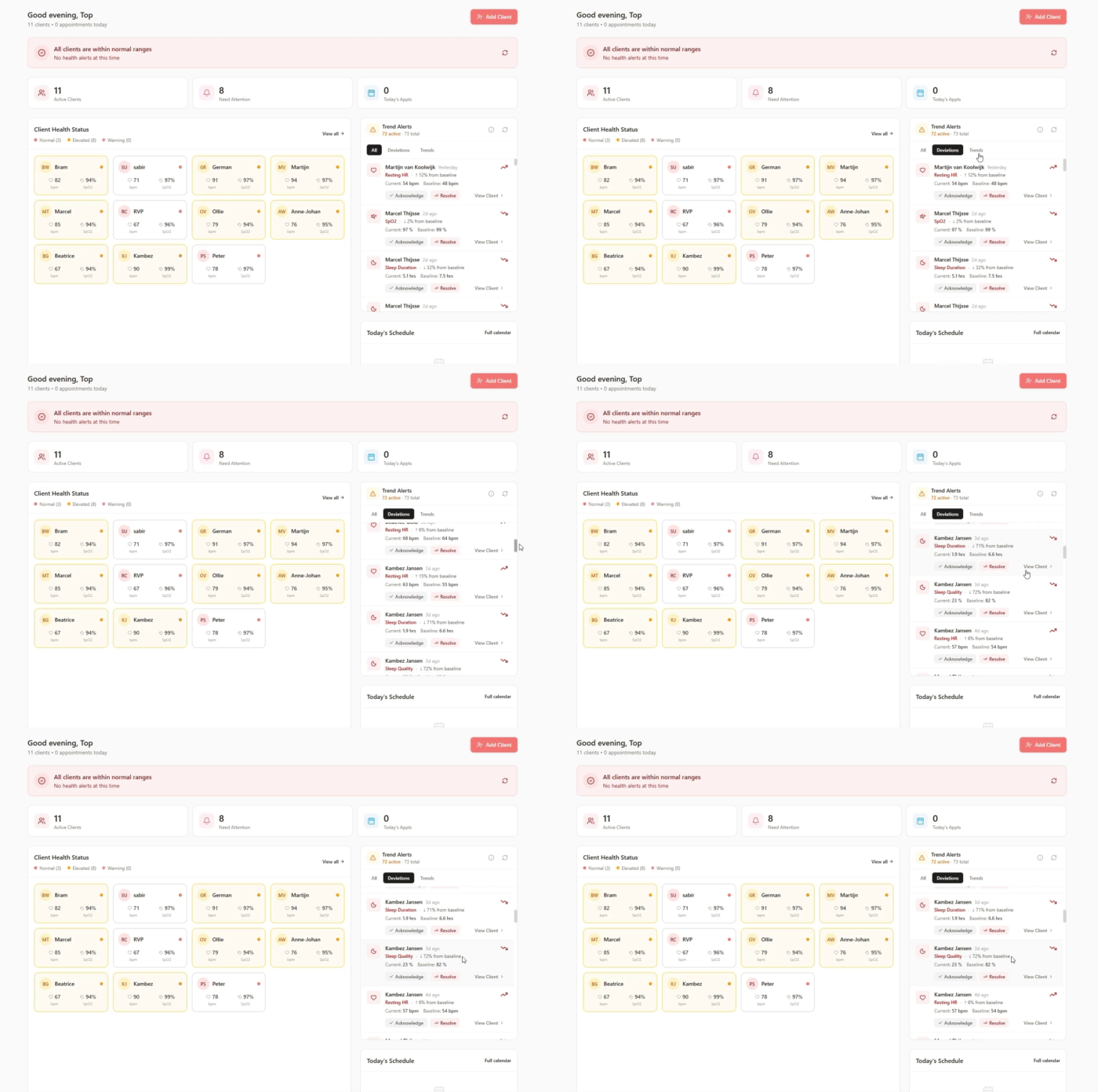
Multi-Metric Intelligence Alerts analyze patterns across multiple vital signs, not just single datapoints, reducing false alarms
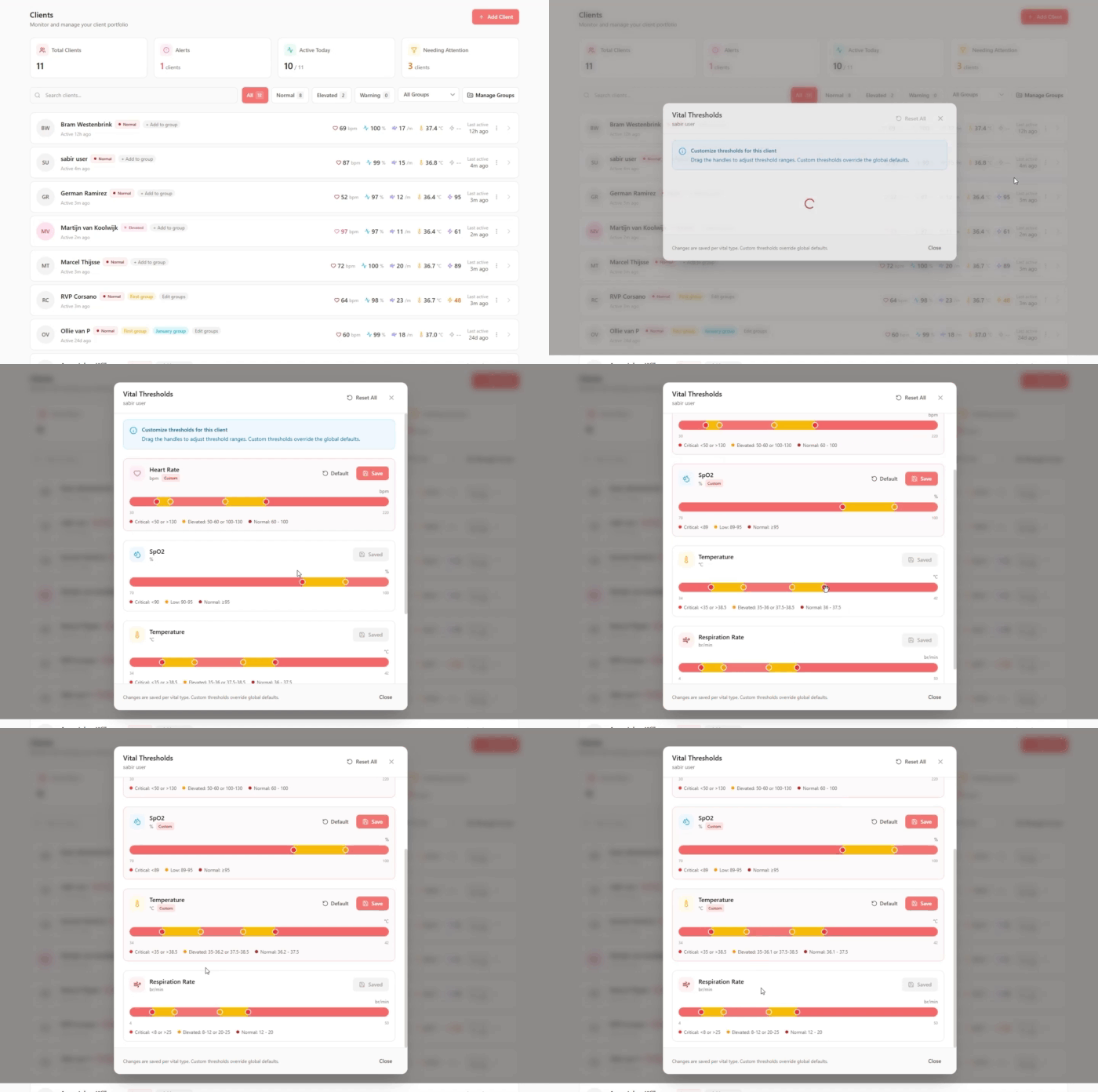
Customizable Thresholds Set alert sensitivity for each client based on their goals, conditions, and individual needs
Smart Timing Notifications are batched intelligently to avoid overwhelming you, with critical alerts always coming through immediately
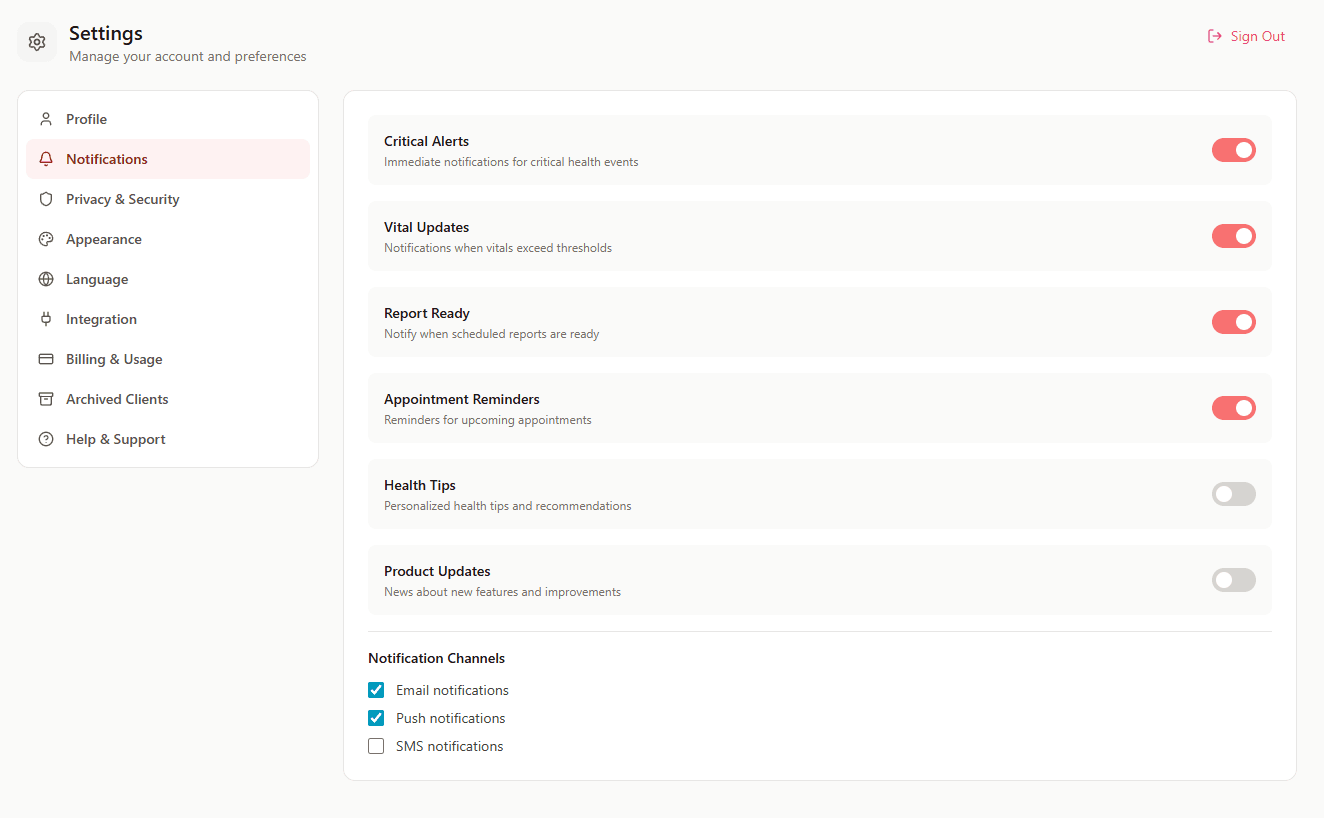
Notification Preferences
Choose which notifications you want to receive based on your needs.
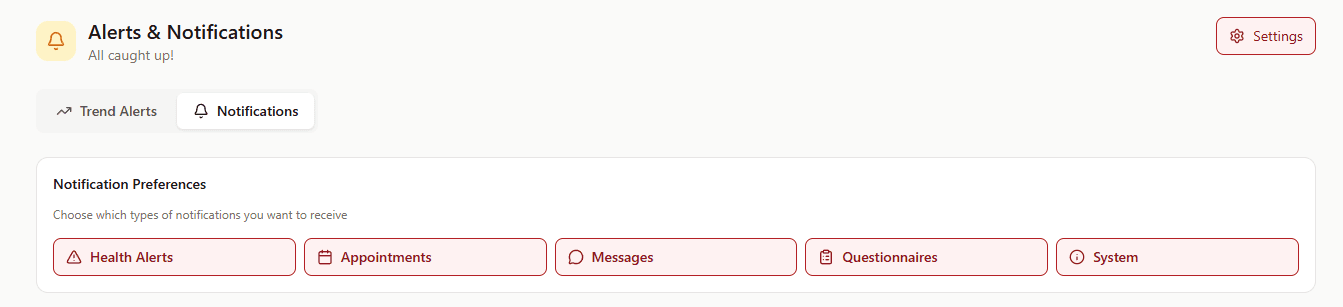
Notification Types Select the categories of updates you want to be notified about.
Multi-Channel Notifications Choose how you receive notifications - email, push, or SMS.
How It Works
1. Baseline Learning Phase CardioMood establishes each client's normal ranges during their first 2-4 weeks of device wear
2. Continuous Monitoring The system analyzes incoming vital signs 24/7, comparing current data against baselines and looking for concerning patterns
3. Intelligent Alert Triggering When meaningful deviations are detected, the system generates an alert with context and recommended actions
4. You Receive Notifications Get alerts via dashboard, email, or SMS - choose your preferred channels
Real-World Example
The Silent Overtrainer
Thursday evening at 7 PM, you receive a moderate-priority alert: "Rachel - Declining Recovery Pattern Detected."
You open the notification. The system shows you that Rachel's HRV has dropped 18% over the past 5 days, her resting heart rate is up 6 bpm, and her readiness scores have declined from her typical 82 to 64. All while her training volume from her workout tracker shows she's been pushing harder than usual.
Classic overtraining syndrome - but Rachel hasn't mentioned feeling tired or struggling. She's motivated, driven, and powering through the fatigue signals her body is sending.
You send her a quick message: "Hey Rachel, I'm seeing some patterns in your recovery data that suggest your body needs more rest. Can we hop on a quick call tomorrow to adjust your training plan?"
She's surprised - she felt fine, maybe a bit more tired than usual, but nothing concerning. You show her the data. Together, you implement a recovery week. Two weeks later, her metrics are back to baseline and she hits a new personal record in her next workout.
Without Smart Alerts, you wouldn't have caught this until Rachel mentioned burnout symptoms, got injured, or missed several sessions. Instead, you intervened early and demonstrated the exact value that justifies your premium coaching fees.
What Makes CardioMood's Alerts Different
Generic fitness trackers send alerts based on arbitrary thresholds - "Your resting heart rate is above 70 bpm!" without knowing if that's normal for you. Practice management tools might remind you to follow up with clients, but they have no health data awareness.
CardioMood Smart Alerts work with medical-grade physiological data validated in clinical studies. The system knows each client's individual baselines because it's been continuously tracking their vitals with 99.2% accuracy. When Rachel's HRV drops to 48ms, the system knows that's significant for her even though it might be perfectly normal for another client.
More importantly, alerts analyze multiple metrics together. A single elevated heart rate reading means nothing. But elevated heart rate + declining HRV + poor sleep quality + reduced readiness score = a pattern that indicates real concern. This multi-metric intelligence dramatically reduces false alarms while catching genuine issues early.
Getting Started
Start with default settings - The system's standard alert thresholds work well for most clients initially
Review your first week of alerts - Adjust sensitivity based on your practice style and client needs
Set up notifications - Receive notifications for health events, appointments, messages, and updates through email, push, or SMS.
Frequently Asked Questions
Will I get overwhelmed with constant notifications? No. Smart Alerts use intelligent batching - routine alerts are grouped into daily or weekly digests, while only truly critical issues trigger immediate notifications.
How does the system know what's "abnormal" for each client? During the first 2-4 weeks, CardioMood establishes individual baseline ranges for each metric. The system then monitors for statistically significant deviations from these personal norms, not generic population averages.
What happens if I miss an alert? Alerts remain in your dashboard notification center until you mark them as reviewed. Critical alerts will also be re-sent if not acknowledged within a specified timeframe you configure.
How accurate are the alerts - do I get false alarms? The multi-metric analysis significantly reduces false positives. Most coaches report that 80-90% of alerts lead to meaningful coaching interventions. You can fine-tune sensitivity to match your preferences.
Ready to stay ahead of client health issues? Experience proactive coaching with Smart Alerts that catch problems before they become serious.