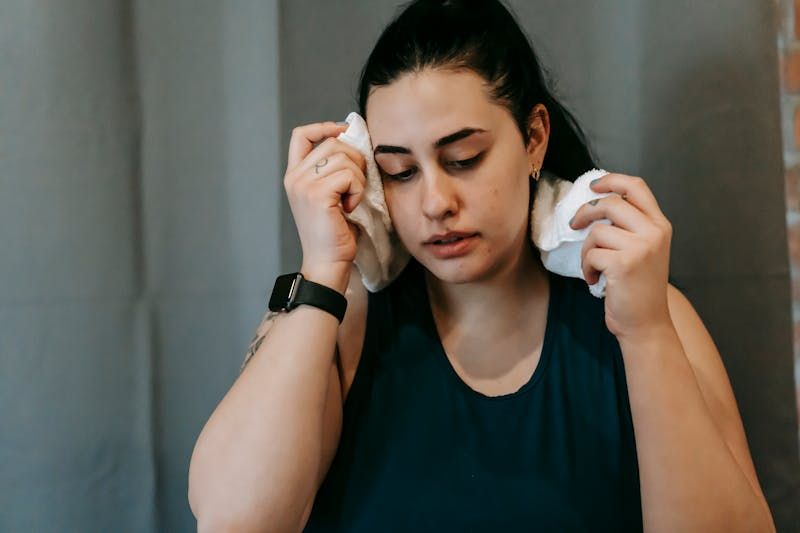
You know the conversation well.
"I'm just tired."
"It's normal to feel this way."
"Everyone's stressed - I'll be fine."
Your client sits across from you, exhausted. Dark circles under their eyes. Third coffee of the morning. But when you suggest they might be burned out, they brush it off. They minimize. They rationalize. They promise to "just push through."
This isn't denial. It's something deeper.
The Invisible Nature of Burnout
Unlike a broken bone or a fever, burnout doesn't show up on a thermometer. There's no visible wound. No clear diagnosis. Just a vague, creeping exhaustion that clients have learned to ignore - or worse, to wear as a badge of honor.
When stress is invisible, it's easy to dismiss. Without proof, people default to their internal narrative: "I'm probably just being dramatic. Other people have it worse. I should be able to handle this."
This psychological barrier isn't a character flaw. It's a gap in information. And that gap keeps your clients stuck in cycles of exhaustion they can't name and won't address.
The Moment Everything Changes
(Chad) CardioMood testimonial with captions.mp4
Wellness professional shares how CardioMood helps clients finally understand their burnout through real-time biometric data
"When they SEE it, they believe it."
This simple statement from a wellness professional captures the transformative power of data visualization. Not more advice. Not another pep talk. Just clear, undeniable evidence of what their body has been trying to tell them.
The shift happens when exhaustion stops being a feeling and becomes a fact.
What the Data Actually Shows
CardioMood tracks the biomarkers that tell the real story of stress and recovery:
Heart Rate Variability (HRV)
Think of HRV as your body's resilience score. It measures the tiny variations in time between heartbeats - a sign of how well your nervous system adapts to stress.
High HRV = Your body is flexible, recovered, ready to handle challenges
Low HRV = Your system is rigid, depleted, running on fumes
When clients see their HRV dropping day after day, it's not subjective. It's physiological proof that "pushing through" is pushing them closer to breakdown.
Continuous Stress Tracking
Here's what spot-checks miss: the six-hour stress spike your client doesn't even remember.
Maybe it was back-to-back meetings. Maybe it was that tense email exchange. Maybe it was the mental load of juggling everything at once. CardioMood captures it all - continuously, automatically, without requiring your client to self-report or remember.
When you can show someone, "Look - your stress was elevated for six hours yesterday," the conversation shifts from opinion to observation.
Recovery Scores
Sleep apps tell you when you slept. CardioMood tells you if that sleep actually restored you.
Recovery scores combine HRV, resting heart rate, and sleep quality to answer the question that matters most: "Did my body actually recover last night?"
When the answer is consistently "no," clients finally understand why willpower isn't working. Their body hasn't been given what it needs to bounce back.
From Subjective to Objective: The Data-Driven Conversation
Without data, wellness conversations sound like this:
Practitioner: "You need to manage your stress better."
Client: "I know, I know. I'll try."
With CardioMood, the conversation transforms:
Practitioner: "Your HRV has dropped 40% over the past two weeks. Your stress levels were critically elevated for six hours yesterday, and your recovery score shows you haven't had a restorative night of sleep in five days."
Client: "...Oh."
That pause? That's the moment of recognition. The moment denial dissolves. The moment change becomes possible.
Medical-Grade Accuracy That Actually Matters
Here's why accuracy isn't just a technical spec - it's the foundation of belief.
CardioMood delivers 99.2% accuracy validated against clinical ECG. That means when it shows elevated stress or declining HRV, you and your client can trust it. No second-guessing. No "maybe the device is off."
When clients trust the data, they trust the recommendations that follow. They stop dismissing their exhaustion. They start making the changes they've been avoiding.
The Wearable They'll Actually Wear
You've probably seen it before: the fitness tracker that lives in a drawer after week two. The monitoring device that's "too annoying" or "too complicated."
CardioMood was designed with real human behavior in mind:
- Six-day battery life - Clients charge it once a week, not every night
- Automatic syncing - No manual logging, no data entry, no friction
- Comfortable enough to forget - They barely notice they're wearing it
Because the best health tool is the one people actually use. Consistently. Without thinking about it.
The Changes That Follow
Here's what happens when clients finally see the proof:
They stop scheduling back-to-back meetings. They protect their mornings. They actually take that vacation they've been postponing. They say no to the commitment that would push them over the edge.
Not because you told them to. Because their body told them - and they finally listened.
From Guessing to Knowing
For too long, burnout conversations have relied on vague assessments and subjective feelings. Clients leave sessions with good intentions but no real conviction.
CardioMood changes the equation. It makes the invisible visible. It transforms "I think I'm stressed" into "I can see exactly when and how my body is struggling."
That's not just data. That's empowerment.
When your clients can SEE it, they believe it. And when they believe it, they actually make changes.
Ready to transform how your clients understand their stress and recovery? Learn more about CardioMood's medical-grade wearable technology and how wellness professionals are using real-time biometric data to break through burnout.
Featured image: Pexels: A Young Woman Using a Towel at the Gym